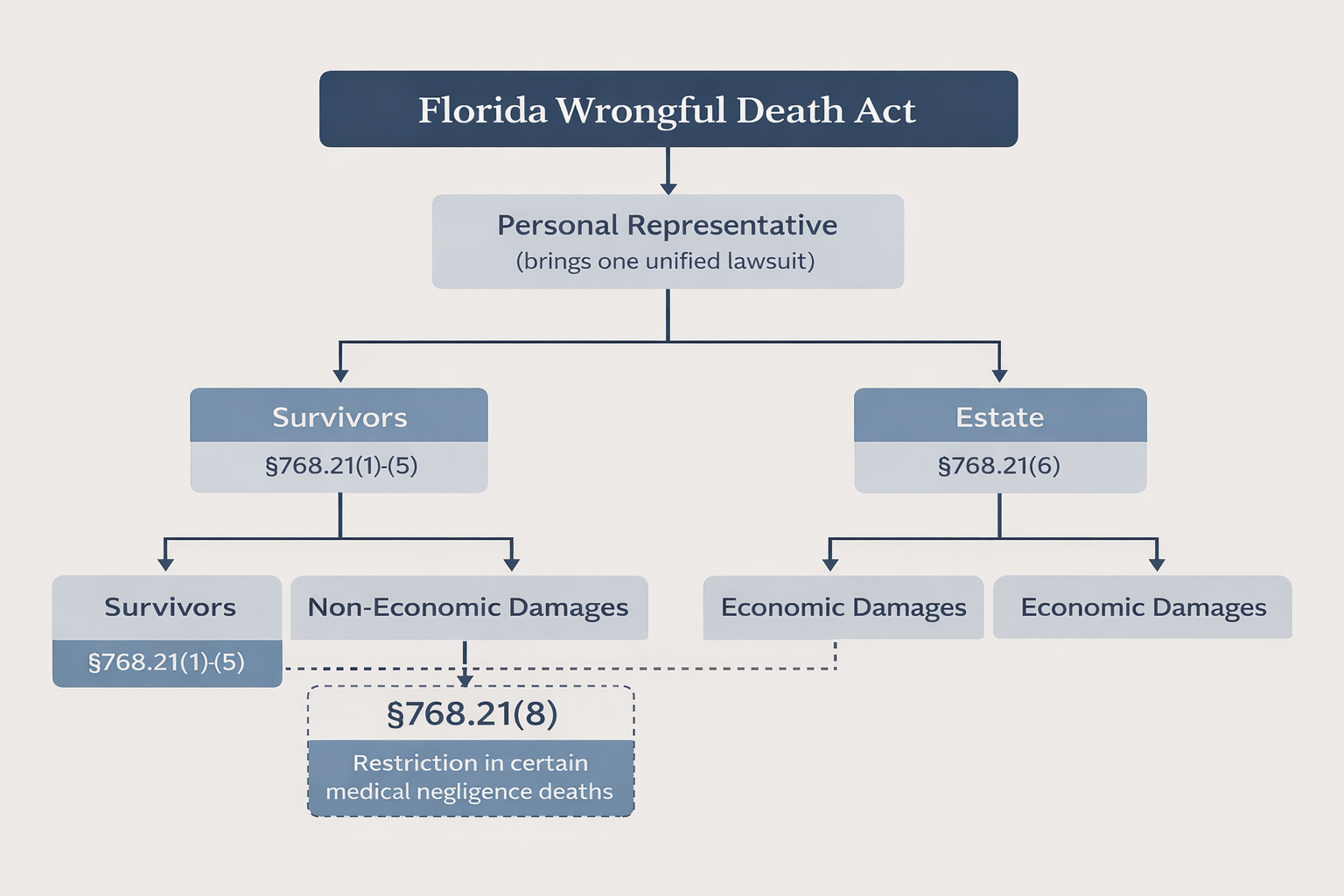
What This Diagram Shows
The 1972 revision of Florida’s Wrongful Death Act reorganized a confused and overlapping body of law into a single, unified system. Instead of allowing multiple lawsuits arising from the same death, the legislature required that one wrongful death action be brought by the personal representative on behalf of both the survivors and the estate. That reform was intended to eliminate the multiplicity of suits and uncertainty over damages that had existed under prior law. Florida AGO on Wrongful Death A… FSC Opinion on the 1972 New Wro…
The diagram makes visible the central design of the 1972 Act: the estate carries the decedent’s financial losses, while the survivors carry the human losses created by the death. The estate, as a legal entity, may recover economic damages such as medical expenses, funeral costs, and certain lost earnings. Survivors, by contrast, may recover for relational and emotional harms such as loss of companionship, parental guidance, and mental pain and suffering. That distinction is fundamental because an estate cannot experience grief or emotional loss; only human beings can. The 1972 Act deliberately separated these two kinds of harm within one coordinated framework. Florida AG Comments on Wrongful…
Subsection (8), enacted later in 1990, did not change the underlying standard of medical negligence. It changed the damages structure by restricting certain survivors’ ability to recover non-economic damages in defined medical negligence wrongful death cases. When that happens, what may remain is only the estate’s economic claim. If those economic damages are small, the case may become difficult or impossible to pursue in practice. This is why Subsection (8) operates not as a change in negligence law itself, but as a structural limitation embedded within the damages framework created by the 1972 revision.